Deep Office Cleaning Services
Deep Office Cleaning by Clean Impact: Boost Health & Productivity
Did you know that office workers touch an average of 300-400 surfaces before lunchtime? Yet most standard cleaning routines only address about 30% of those surfaces. That’s not an opinion—it’s backed by research that tracked actual workplace contamination patterns over five years.
The difference between “clean” and truly clean isn’t subtle anymore. Post-pandemic workplace standards changed everything. Employees notice. Clients notice. And most importantly, your bottom line notices when people start taking sick days or avoiding the office altogether.
Deep office cleaning services represent something different than your regular Monday-through-Friday maintenance. This is about reaching places cleaning crews forget, eliminating accumulated dust that hides bacteria, and restoring your workspace to a state that actually promotes productivity rather than breeding illness.
Why Standard Cleaning Doesn’t Cut It Anymore
Here’s where most office managers get frustrated. The cleaning crew comes in, empties trash, vacuums the obvious areas, and leaves. Everything looks fine until you run your finger along the top of a light fixture—and there it is. Thick dust. Sticky residue. That feeling of “this isn’t really clean.”
This happens because daily maintenance and deep office cleaning serve completely different purposes. Daily cleaning manages the visible mess. Deep cleaning addresses the invisible threat.
Consider this scenario: A 5,000 square foot office building receives regular twice-weekly cleaning. The vacuum runs, bathrooms get refreshed, desks are tidied. But HVAC vents go uncleaned for months. Baseboards accumulate dust. Ceiling tiles collect grime. Air quality actually deteriorates, even though the office looks neat.
Research from the Journal of Environmental Health showed that offices with quarterly deep cleaning experiences a 37% reduction in employee sick days compared to those relying solely on surface cleaning. That number matters in real dollars—sick leave costs money.
The Hidden Contaminants Living in Your Office
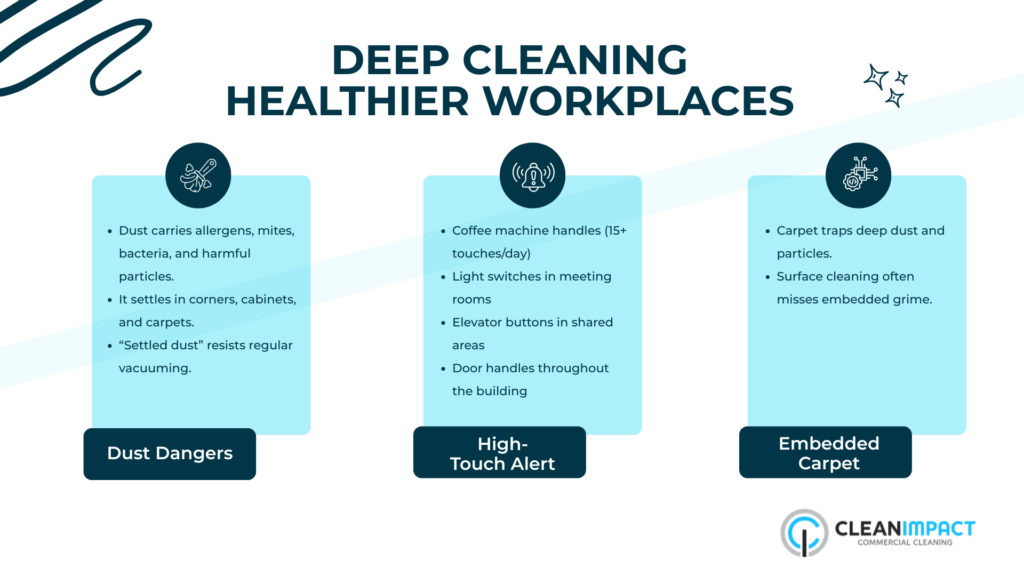
Dust isn’t just annoying. It’s a delivery vehicle for allergens, dust mites, bacteria spores, and potentially harmful particles. When dust settles undisturbed in corners, on top of cabinets, and within carpet fibers, it transforms into what scientists call “settled dust”—a stabilized layer that resists normal vacuuming.
High-touch surfaces deserve special mention because they’re where germs make their stand. Think about your office reality:
- The coffee machine handle touched by 15 people daily
- Conference room light switches flicked by dozens of hands
- Elevator buttons in shared spaces
- Door handles throughout the building
- Keyboard and mouse surfaces at individual workstations
Standard cleaning might wipe these down once. Deep cleaning addresses them with antimicrobial protocols that eliminate not just visible dirt but also microscopic organisms. The difference? Your team stays healthier.
Another often-overlooked issue: carpet accumulation. Regular vacuuming removes surface debris, but it doesn’t reach the deeper carpet pile where allergens, dust mites, and bacteria colonies establish themselves. A professional carpet deep clean using hot water extraction methods can remove embedded contaminants that a standard vacuum simply cannot reach—even though you can’t see them.
What Professional Deep Office Cleaning Actually Includes
Let’s get specific about what separates deep office cleaning from routine maintenance. This isn’t ambiguous. Real deep cleaning follows systematic protocols:
Areas Addressed in Comprehensive Deep Cleaning
| Area | Standard Cleaning | Deep Cleaning |
| Flooring | Vacuum/sweep | Shampoo carpets, strip/wax hard floors, grout cleaning |
| Air Vents | Ignored | Ductwork cleaning, HVAC sanitization, register details |
| Windows | Spot cleaning | Full exterior/interior wash, frame detail, blind cleaning |
| Baseboards | Occasional pass | Detailed wipe-down, stain removal, restoration |
| Ceiling Areas | Not addressed | Tile cleaning, fixture detail, corner cobweb removal |
| Light Fixtures | Surface dust | Complete disassembly, deep sanitization |
| Bathrooms | Daily stocking | Grout restoration, fixture polishing, exhaust vent cleaning |
| High-Touch Surfaces | General wipe | Antimicrobial treatment, multiple-pass protocol |
This systematic approach is what distinguishes professional office deep cleaning services from hitting the highlights.

The Business Case: Why Deep Cleaning Saves Money
Office managers often view deep cleaning as an expense line item. But economics tells a different story.
A facility with 50 employees spending 8 hours per day at desks generates multiple cost factors:
- Employee sick days averaging 7 per person annually cost roughly $2,500 per employee in lost productivity and benefits
- HVAC system efficiency drops 15% when filters clog with dust, increasing energy costs
- Poor indoor air quality correlates with 15% decrease in cognitive function (Harvard study)
- Facility appearance impacts client perception and contract retention
Now the math shifts. If deep quarterly cleaning reduces sick days by even 2-3 per year per employee, that’s already $5,000+ in recovered productivity for a 50-person office. Add improved HVAC efficiency and reduced energy bills. Factor in preserved client relationships through professional appearance.
Suddenly, comprehensive office cleaning services look like an investment rather than an expense.
One Springfield-area manufacturing firm ran this scenario: They switched from basic cleaning to quarterly deep cleaning services plus twice-weekly maintenance. Year one results showed 31% fewer sick days taken, energy bills dropped 12%, and their client satisfaction scores improved. The deep cleaning service cost increase was offset completely by these measurable gains.
That’s not anecdotal—that’s operational reality.
How Professional Teams Execute Deep Office Cleaning
There’s a methodology here. It’s not random. Professional deep cleaning for offices follows structured procedures:
Phase 1: Assessment & Planning The crew doesn’t just show up. They evaluate the space, identify specific challenges (water stains on ceiling tiles, carpet problem areas, stubborn discoloration), and create a detailed action plan. This prevents wasted effort and ensures nothing gets overlooked.
Phase 2: High-to-Low Systematic Cleaning Professionals work from ceiling to floor because gravity is real. You clean ceiling vents first, then light fixtures, then walls, then baseboards, then floors. Reverse this order and you’re re-contaminating areas you already cleaned.
Phase 3: Equipment Deployment This is where professional services differ from DIY attempts. They bring industrial-grade equipment—truck-mounted carpet extraction systems, HEPA-filtered vacuums, pressure washers, specialized tools for grout work. These aren’t available at rental shops.
Phase 4: Quality Verification Reputable deep cleaning companies perform random inspections of their own work. They check corners, verify chemical concentrations, test surface cleanliness. This accountability prevents the “looks clean but really isn’t” problem.
The Chemistry Behind Actually Killing What You Can’t See
Here’s something worth understanding: Not all cleaning products work the same way. Some just move dirt around.
Professional cleaning companies use closed-loop dilution systems that mix green-certified chemicals to exact specifications. This matters because wrong concentrations mean either ineffective cleaning or chemical overkill that leaves residue attracting more dirt and potentially harming respiratory health.
The right chemistry targets specific problems:
- Antimicrobial agents eliminate surface bacteria and viruses
- Enzymatic cleaners break down organic matter that causes odors
- Surfactants lift oil-based dirt from surfaces
- pH-balanced solutions prevent damage to different materials
A concrete example: A typical office restroom stall might have mineral deposits, soap residue, and biological growth. Generic all-purpose cleaner addresses surface appearance. Professional deep cleaning applies specific products that address each contamination type, then verification ensures actual sanitization occurred.
This matters because employees sense cleanliness differently than they see it. Poor sanitation feeling (slippery floors, chemical smell, or that inexplicable “ick” factor) drives stress and reduces willingness to work on-site.
Special Situations: When Deep Cleaning Becomes Essential
Some offices definitely need deep cleaning services more urgently than others. Recognize your situation:
Post-Construction or Renovation: Dust penetrates absolutely everywhere during construction. HVAC systems distribute construction particles throughout the building. Standard cleaning cannot address this level of contamination. You need professional post-construction cleaning with HEPA equipment.
After Illness Outbreak: When flu, COVID, or norovirus spreads through an office, regular maintenance doesn’t restore safety. Antimicrobial deep sanitization targets surfaces where illness-causing pathogens actually survive.
Pre-Client Visits or Events: First impressions matter in business. Before major client meetings, media visits, or events, deep cleaning ensures your space communicates competence and professionalism.
Seasonal Transitions: Spring and fall offer natural times to refresh your space. Pollen season requires thorough air filter changes and vent cleaning. Winter’s drier air compounds dust problems.
Long-Term Neglect: Be honest. Sometimes offices skip cleaning services or accept mediocre work for years. Accumulated damage (stained carpet, grimy baseboards, cloudy windows) requires professional restoration, not just maintenance.
Choosing the Right Deep Cleaning Partner
Not all cleaning companies offer equivalent service. Watch for these differentiators when evaluating professional office cleaning services:
Trained & Certified Staff: Real professional companies maintain ongoing training programs for their teams. Cleaners should understand chemical safety, equipment operation, and quality standards. Companies like Clean Impact invest in training platforms that grade performance and reward competency.
Technology & Systems: The best companies use technology for accountability. Digital checklists ensure nothing gets skipped. Scheduling apps confirm staff arrival. Messaging systems keep you informed. This transparency replaces the uncertainty of wondering whether your space actually got cleaned properly.
Quality Assurance Protocols: They should conduct random inspections of their own work. If a cleaning company can’t describe their quality verification process, that’s a red flag. Random checks prove they take responsibility.
Eco-Friendly Practices: Green-certified, environmentally responsible products protect both your workspace and your team’s long-term health. Harsh chemical residues don’t disappear—they remain on surfaces and affect air quality.
Local Expertise & Availability: Springfield-area facilities have specific needs (humidity factors, local dust patterns, water quality). Local companies understand these nuances. Plus, they’re actually accessible when emergencies occur.
References & Reputation: Legitimate companies provide references and display authentic reviews. Look at what clients specifically praise. Generic praise (“great service!”) differs from specific feedback (“Tina transformed our office appearance and never misses details”).
The Reality Check: Frequency Matters
Here’s the honesty moment: Deep cleaning isn’t a one-time solution that solves problems forever. It’s not like getting your house painted. Contamination reaccumulates. Dust returns. That’s just how physics works.
Most facilities benefit from quarterly deep cleaning combined with weekly or twice-weekly maintenance. This rhythm maintains progress without letting problems rebuild.
Think of it like vehicle maintenance. Oil changes (daily cleaning) keep things running. Major services (deep cleaning) prevent system breakdown. You need both.
A typical deep cleaning schedule:
- Weekly maintenance: Daily surfaces, trash removal, visible areas
- Quarterly deep clean: Carpet shampooing, vent cleaning, grout work, wall washing
- Annual deep refresh: HVAC system service, window washing, baseboard-to-ceiling detail
This prevents that frustrating cycle where offices get progressively dirtier despite regular cleaning.
Addressing the Concerns Facility Managers Actually Have
Real facility managers worry about these things:
“Will deep cleaning disrupt our operation?” Professional teams schedule during off-hours or coordinate work around your schedule. Most deep cleaning happens after hours or weekends. Planning prevents disruption.
“What if the crew doesn’t show up?” Reputable companies maintain floats—backup teams ready to deploy. Reliability means they have systems ensuring your service happens regardless. Call-offs should be virtually non-existent.
“How do I know the work actually happened?” Quality companies provide photo documentation, detailed reports, and digital inspections. You shouldn’t have to wonder.
“Is this actually worth the cost?” Track measurable outcomes: sick days taken, energy bills, client feedback. Most facilities recover the deep cleaning investment within three months through improved metrics.

Taking Action: Your Next Step
Your office space communicates something to employees and clients whether you intend it to or not. Visible dust, unexplained odors, and that general feeling of grime create stress and reduce productivity. People don’t consciously register these factors as “I’m working somewhere dirty,” but their bodies know something isn’t right.
Deep office cleaning services change that equation. You’re not just making things look acceptable—you’re genuinely improving the environment where your team spends 2,000 hours annually.
The best facility managers stop accepting mediocre cleaning and partner with companies that actually understand what thoroughness means. Companies like Clean Impact LLC in Springfield specialize in exactly this—transforming workspaces from “looks fine” to genuinely clean and healthy.
If your current cleaning situation feels like it’s underperforming, if you’re tired of dust on surfaces that should be spotless, or if you’ve simply accepted that offices are naturally grubby—stop. That’s not reality. That’s just what you’ve experienced so far.
Reach out for a free consultation. Discuss your specific challenges with local cleaning experts who understand Springfield’s facility landscape. See the difference between standard cleaning and actual deep restoration. Your team’s health and productivity deserve more than you’ve probably been accepting.
The office doesn’t have to feel dingy. With professional deep cleaning services from experienced teams, it actually becomes a workspace where people want to be.