Warehouse Cleaning Springfield il
Warehouse Cleaning Services in Springfield, IL: Clean Impact
Industrial facilities generate 30 times more waste than standard commercial offices. That’s not a minor detail—that’s an operational reality that changes everything about how you need to approach warehouse cleaning.
Most warehouse managers wing it. They assign cleaning duties to whoever isn’t busy. A facility gets swept occasionally, maybe mopped when someone complains about sticky floors. Meanwhile, dust accumulates in corners, equipment functions suboptimally, and nobody’s actually tracking whether anything’s getting better or worse.
Professional warehouse cleaning Springfield IL isn’t luxury—it’s operational necessity. A properly maintained industrial facility runs smoother, passes compliance audits, and keeps employees from getting hurt on contaminated surfaces. Let’s talk about why this matters more than most warehouse operators realize.
The Warehouse Cleaning Problem Nobody Wants to Admit
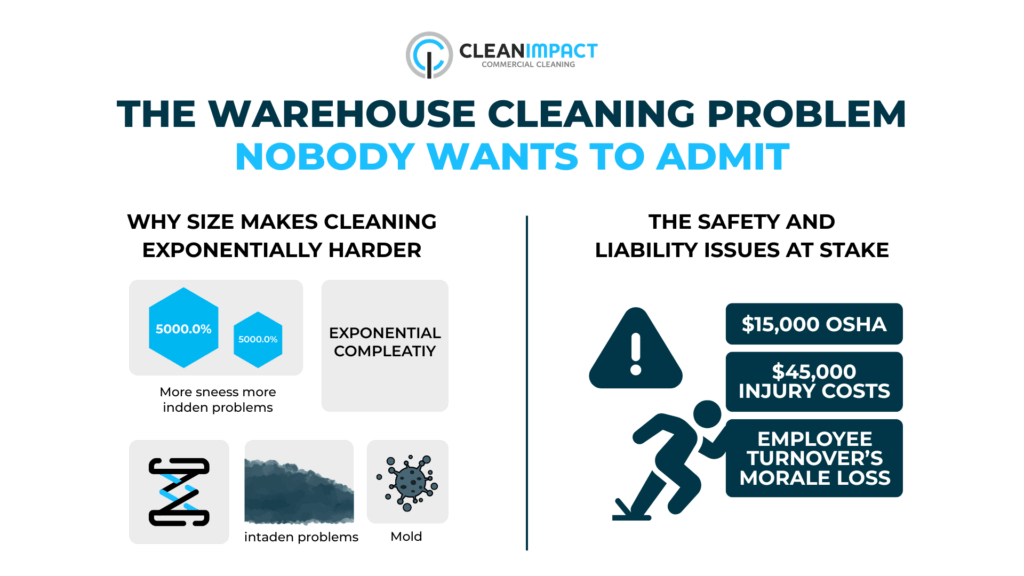
Why Size Makes Cleaning Exponentially Harder
A 50,000-square-foot warehouse isn’t just 10 times bigger than a 5,000-square-foot space—it’s exponentially more complex. High-bay areas require specialized lift equipment to reach ceiling fixtures. Concrete floors develop cracks and crevices where dirt embeds itself. Multiple storage zones create isolated pockets where contamination goes unnoticed.
One Springfield automotive parts warehouse manager thought hiring a couple extra part-time staff would solve cleaning issues. Six months in, he discovered mold growing in shadowed corners where moisture accumulated. The cost to remediate? $28,000. Professional industrial cleaning would’ve prevented that entirely through proper moisture management and systematic inspection protocols.
The Safety and Liability Issues at Stake
OSHA doesn’t joke about facility cleanliness. Slips, trips, and falls from debris or spilled substances create worker injury liability. One spill left improperly cleaned resulted in a $15,000 fine for a Springfield distribution center. But the injury costs were worse—an employee slipped on residual oil, broke their wrist, and triggered workers’ compensation claims totaling $45,000 over three years.Beyond legal liability, dirty warehouses undermine employee confidence. Workers don’t feel valued when they’re asked to operate in filthy conditions. Turnover increases. Training costs spike. What started as cutting corners on cleaning ends up costing far more in human resources disruption.
How Dirty Warehouses Tank Productivity and Inventory
The Hidden Cost of Poor Facility Maintenance
Dust on products equals liability. A contaminated shipment going to a customer creates reputation damage. Returned inventory. Potential recalls if the contamination is serious enough. One food storage warehouse learned this lesson when dust contamination required reprocessing an entire batch—$120,000 in lost productivity.
Equipment operates less efficiently in dirty environments. Forklifts accumulate grime. Machinery functions with preventable friction. Inventory counts become harder when storage areas are disorganized and dirty. That’s not just annoying—that’s margin loss. A 2% efficiency drop in a 100-person warehouse operation costs roughly $200,000 annually in lost output.
Contamination Risks That Keep Operations Managers Up at Night
Pharmaceutical warehouses, food storage facilities, and chemical distribution centers can’t tolerate contamination. One Springfield medical supply warehouse discovered non-sterile conditions during an audit, lost their certification, and took six months to restore operations. That’s devastating financially.
Cross-contamination is real. Different product types stored nearby can spoil if cleaning protocols fail. Temperature-controlled warehouses require humidity management during cleaning to prevent condensation damage. These aren’t minor details—they’re operational foundations that separate profitable warehouses from troubled ones.
What Makes Industrial Warehouse Cleaning Different
Heavy Equipment and Specialized Techniques
Warehouse cleaning requires equipment most standard cleaning companies don’t own. Truck-mounted extraction systems for handling large concrete areas. High-pressure washers rated for industrial-strength residue removal. Lift equipment for accessing high-bay sections. Specialized machinery for grinding away embedded stains.
One Springfield manufacturing warehouse attempted DIY cleaning with standard mops and vacuums. Within two years, their epoxy floor coating deteriorated beyond repair. Professional industrial cleaning uses proper techniques that preserve surface integrity while removing contamination. The floor lasted 8 years under professional care instead of 2 years under casual attention.
Compliance Standards That Matter
OSHA, EPA, and industry-specific regulations create non-negotiable cleanliness standards. Food service regulations demand documented sanitation. Pharmaceutical facilities require sterile protocols. Chemical storage areas need specific hazard-handling procedures. Generic cleaning companies miss these requirements. Industrial cleaning contractors know them.
Documentation matters too. Regulatory inspections require proof that cleaning occurred according to standards. Professional warehouse cleaning services maintain records, photos, and inspection logs that satisfy auditors.
Strategic Warehouse Cleaning Plans That Actually Work
Daily Maintenance vs. Deep Cleaning Cycles
The best industrial facilities use tiered approaches. Daily sweeping and surface cleaning prevents accumulation. Weekly floor care addresses tracked-in debris and minor spills. Monthly deep cleaning with specialized equipment handles embedded contamination. Quarterly intensive procedures refresh high-stress areas.
This layered system keeps facilities inspection-ready without disrupting operations. Small daily investments prevent emergencies that halt productivity.
High-Risk Areas Demanding Priority Attention
Loading Docks: Heavy traffic areas accumulating dirt, debris, and potential chemical residue. Daily attention required.
Storage Zones: Dusty shelving, inventory staging areas, pallet storage requiring regular deep cleaning.
Equipment Zones: Machinery, forklifts, and operational equipment needing degreasing and contamination removal.
Climate-Controlled Areas: Temperature-sensitive zones requiring humidity-aware cleaning to prevent condensation damage.
Office/Break Rooms: Employee spaces demanding higher cleanliness standards affecting morale and health.
Clean Impact LLC’s Industrial Expertise
Warehouse cleaning Springfield IL requires partners who understand industrial operations. Clean Impact LLC brings specialized experience with large-facility cleaning, compliance documentation, and industrial-grade equipment. We know that a 50,000-square-foot warehouse needs different strategies than a 5,000-square-foot space.
Our warehouse cleaning Springfield IL services include EPA-compliant products, OSHA-aware protocols, and flexibility for 24-hour operations requiring after-hours work. We maintain documentation for audit readiness and adjust cleaning intensity based on your facility’s specific risk profile.
Get Your Warehouse Facility-Ready
Dirty warehouses cost money through inefficiency, liability, contamination, and lost productivity. Clean facilities operate smoother, pass inspections, and maintain employee safety and morale. The question isn’t whether you can afford professional warehouse cleaning—it’s whether you can afford not to have it.
Contact Clean Impact LLC for a free industrial facility assessment. Let’s evaluate your warehouse environment and develop a customized industrial warehouse cleaning plan that protects your operations, your reputation, and your bottom line.